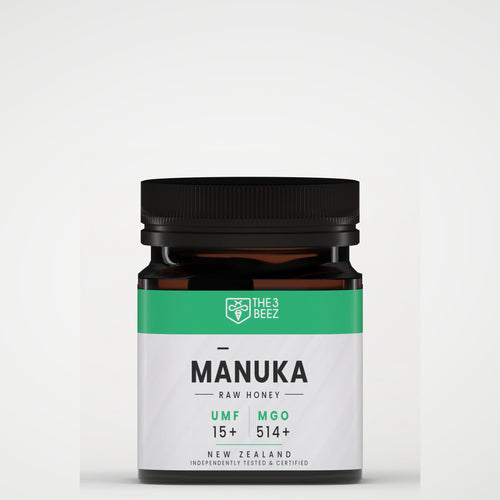
Tiryaq Honey | 200 g
166 SAR
MGO — methylglyoxal — is an antibacterial compound almost exclusive to Manuka honey, and the secret of its signature properties.
It forms naturally in the nectar of the manuka tree's blossom, and the bees carry it into the honey. The higher the MGO number on the jar, the higher the concentration of this compound — and of the other beneficial compounds with it.
MGO is the measure of Manuka's strength — the higher the number, the higher the concentration of the other beneficial compounds.
MGO is measured in milligrams per kilogram, and is confirmed by an independent lab certificate for every batch — not by a claim on the label.
The UMF™ grade gathers several quality markers into one number, and its licence is granted only after the New Zealand association's audit.
As the MGO grade climbs, the concentration of the other beneficial compounds in the same jar climbs with it.
MGO


Concentration of the other beneficial compounds
Natural prebiotics For balanced digestion
Antioxidants At high concentration
MGO For stronger immunity
Pure energy That lasts longer
Polyphenols For cell protection
Raw and rich Unprocessed
Natural prebiotics that feed the beneficial bacteria in your gut, supporting smoother digestion, better nutrient absorption and a lasting inner balance.
A high concentration of antioxidants that stands against daily oxidative stress — among the highest found in natural honeys.
The antibacterial compound almost exclusive to Manuka — and what makes it a daily supporter of the immune system.
Natural, unprocessed carbohydrates that give steady, clean energy — without the crash of manufactured sugar.
Plant compounds that support the health of your cells, counted among what distinguishes high-grade Manuka.
Unpasteurized and unprocessed, so it keeps its elements as they left the hive — supporting gut, immunity and cells together.
Manuka honey is produced only in New Zealand, from the nectar of the manuka tree's blossom, which opens for just two to six weeks in summer — the bees gather its nectar in that narrow window or not at all.
All our jars are harvested and packed in New Zealand under UMF™ licence No. 2986, and you can open your batch's certificate by scanning the QR code printed on the label.
 The Far North
Waikato
The Far South
The Far North
Waikato
The Far South
New Zealand
Our beekeepers practise traditional beekeeping that puts the bees' care and their environment before everything. We look after the bees — and they look after us.
We deliberately keep the number of hives at each site low, so every colony finds abundant nectar and room to thrive — never any crowding, and a lasting balance with the environment.
Our hives stay where they are except in rare cases — they are not trucked around to pollinate crops as in industrial beekeeping. Stability is rest for the bees, and quality in the honey.
We always leave the colony enough of its own honey to see out the winter — and we never feed our bees sugar solutions.
Deep in New Zealand's manuka forests, far from pesticides, pollution and urban agriculture — then every harvest is tested at an independent laboratory to prove its purity and strength.
The code couldn't be applied — it's invalid or doesn't apply to your current cart
Your order arrives in 2 to 5 days
Pay safely and securely