Beeswax and the Hexagon: Why This Shape in Particular?
July 29, 2026 · The3Beez
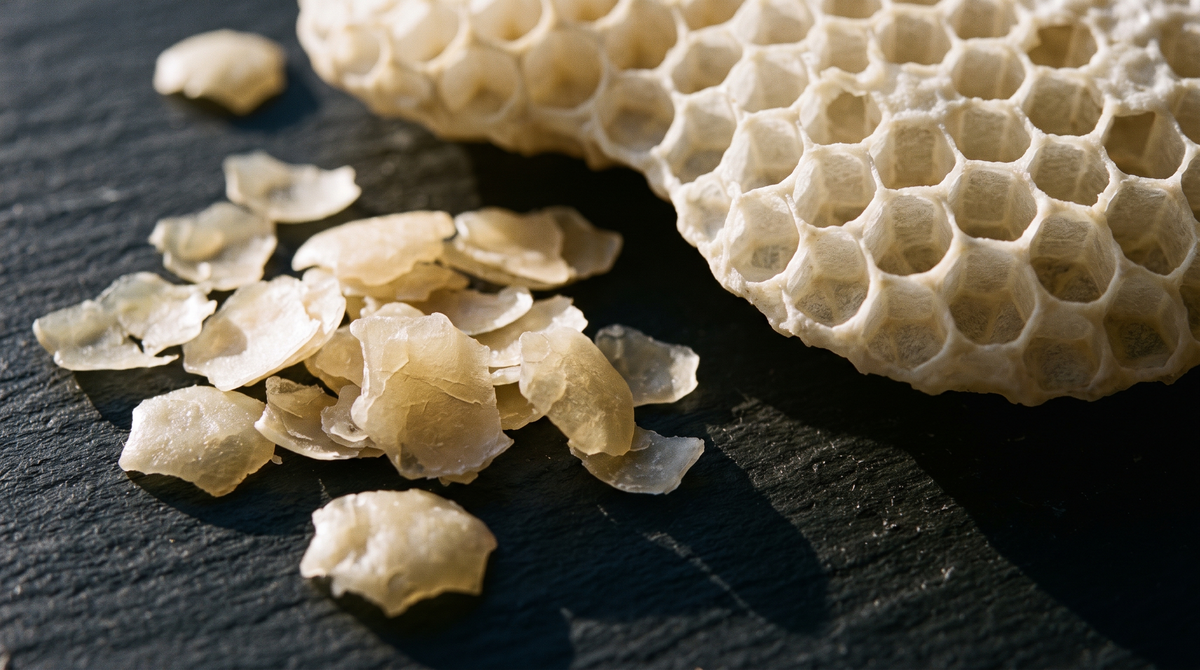
The wax comb is one of the best known shapes in nature, and there are two reasons behind it: one biological, the other mathematical.
Where does the wax come from?
Bees do not gather wax from outside; they secrete it. The worker carries four pairs of wax glands on the underside of her abdomen, and these glands reach their peak activity at roughly twelve to eighteen days of age, according to Bogdanov's reference work on bee product science. The wax scales emerge small and transparent, and the bees then chew and shape them.
What does wax cost?
Here the figures in circulation call for caution. The classical estimate, relayed by the Mid-Atlantic Apiculture Research and Extension Consortium from Whitcomb's 1946 study, is about nine pounds of honey for every pound of wax, roughly 9 to 1. The published literature, however, gives a far wider range: Bogdanov reports that the sugar-to-wax ratio falls between 3 and 30 to 1, and that around 20 to 1 is typical in central Europe. The conclusion is that wax is certainly costly, and that any single precise figure offered without qualification should be treated with caution.
Why the hexagon?
The question is purely geometric: how do you divide an area into equal cells using the least possible length of wall? Only three shapes fill the plane without gaps: the triangle, the square and the regular hexagon. Of these, the hexagon has the smallest perimeter for a given area, which is to say it consumes the least wax.
This remained no more than an old observation until the mathematician Thomas Hales proved it in 1999, in a paper published later, in 2001, as “The Honeycomb Conjecture”: any division of the plane into regions of equal area has a total perimeter at least equal to that of the regular hexagonal tiling.
A caveat worth noting
This result is two-dimensional, which is to say it concerns the cross-section of the comb. The rhombic caps that close the base of the cell in three dimensions are not optimal; the mathematician Fejes Tóth showed that a slightly better closure exists. The hexagon is optimal in the plane, then, and not necessarily in the complete cell.